Acrylic Hybrid vs. Zirconia All-on-4: Cost, Durability & How to Choose
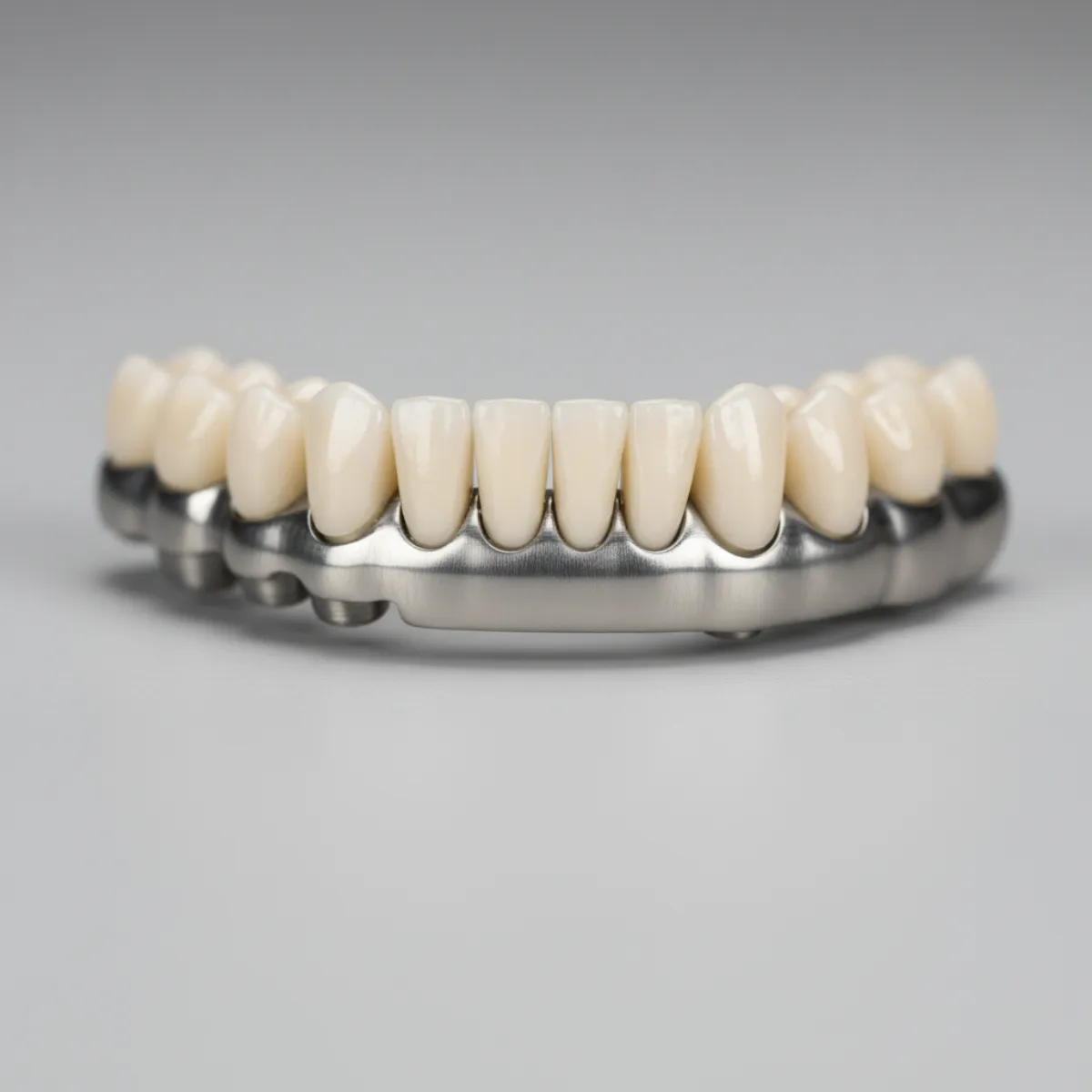
The single decision that moves your All-on-4 price the most isn’t the country — it’s the material your new teeth are made from. Choosing between a titanium-acrylic hybrid and monolithic zirconia changes the cost by thousands of dollars per arch, and it changes how long the result is likely to last.
This page lays out the trade-off in plain terms, using figures from peer-reviewed studies (cited on our sources page) rather than clinic marketing. One honest caveat up front: the research on full-arch implants is dominated by retrospective studies with limited long-term follow-up, so treat every survival number as a useful average — not a guarantee for your mouth.
The two materials you’ll actually choose between
Almost every All-on-4 quote comes down to one of two prosthesis types sitting on top of your implants:
- Titanium bar + acrylic hybrid — denture-grade acrylic teeth fused to a titanium frame. It’s the long-standing, lower-cost option and the one most “starting at” prices refer to.
- Monolithic zirconia — a single, milled block of high-strength ceramic. More expensive, more lifelike, and far more resistant to wear and fracture.
(You may also hear about porcelain-fused options and “premium” acrylics, but the acrylic-hybrid-vs-zirconia split is the one that drives the price and the lifespan.) The implants underneath are usually titanium in both cases; the material conversation is mostly about the teeth.
The cost difference: about $7,800 more per arch for zirconia
A University of Michigan analysis (2020) of 74 full arches found that monolithic zirconia cost roughly $7,829 more per arch to fabricate than a metal-acrylic hybrid. That’s a lab/fabrication difference at one US center in 2020 — so think of it as the size of the gap, not a fixed surcharge. In lower-cost countries the absolute dollar gap is usually smaller, but zirconia is consistently the pricier choice everywhere.
This is exactly the lever our cost planner lets you pull: switch the material from acrylic to zirconia and watch the estimate move, then compare that against the same choice in another country on the cost breakdown.
Durability: zirconia pulls ahead over five years
Upfront price is only half the decision. The Michigan study also tracked how the prostheses held up:
- Zirconia: ~93.7% prosthetic survival at 5 years.
- Metal-acrylic: ~83.0% at 5 years, with a separate cohort reporting acrylic survival as low as ~54% at 5 years and ~32% at 10 years, driven by acrylic fracture.
Crucially, the study found that maintenance and repair costs over time did not differ greatly between the two groups — meaning zirconia’s higher upfront price tends to even out, because the cheaper acrylic option needs more fixing.
What actually goes wrong (and which part)
Here’s a point most sales pages skip: with All-on-4, the implants themselves rarely fail — the prosthesis is the weaker link. In a one-year cohort of 544 implants, implant survival was 98.2% but the restoration survival was 94.4%. Across a large systematic review, the most frequent prosthetic complication was fracture or chipping of the acrylic, and detachment of a prosthetic element happened in about 23.2% of patients (that’s the detachment rate, not the fracture rate — they’re separate problems).
Zirconia’s complications, by contrast, are mostly minor and fixable at a routine visit: loss of the screw-access-channel filling and, in veneered designs, small porcelain chips. Pure monolithic zirconia chips the least. The flip side: when zirconia does fracture, it’s harder to repair than acrylic and doesn’t have acrylic’s slight shock-absorbing give.
How long will it last? Be skeptical of big round numbers
You’ll see “99.8% success” quoted constantly. Treat it carefully: that figure is a conditional rate for implants that already survived past 24 months — it excludes the majority of failures, which happen early. A fairer headline for the long run is the lowest reported long-term figure: about 94.8% implant survival at up to 10 years in the largest cohort.
For a deeper look at the lifespan evidence, see how long All-on-4 implants last.
Which material is right for you?
There’s no universal winner — there’s a fit for your situation:
- Lean toward acrylic hybrid if: budget is the deciding factor, you want the lowest entry price, or you’re comfortable treating the first set as a long-term “workhorse” you may repair or upgrade later.
- Lean toward zirconia if: you want the most durable, lifelike result, you grind/clench (more force on the teeth), or you’d rather pay more once than manage repairs — especially if traveling abroad makes follow-up visits inconvenient.
If you’re still deciding between All-on-4 and a six-implant design, that choice interacts with material and cost too — see All-on-4 vs All-on-6.
Questions worth asking any clinic
- Is the quoted price for an acrylic hybrid or monolithic zirconia — and is that the final prosthesis or a temporary?
- What’s the warranty on the prosthesis specifically (not just the implants)?
- If a tooth chips or the prosthesis fractures, what does a repair cost and who does it?
- For zirconia: is it fully monolithic or veneered? (Monolithic chips less.)
Once you know which material you’re pricing, run both through the cost planner and compare home vs. abroad on the full cost breakdown. Material first, country second — that order keeps the comparison honest.
Medical & financial disclaimer: This article is for general information only and is not medical or financial advice. Prices are market estimate ranges, not quotes. Consult a licensed dentist and verify any clinic independently before treatment.